
Why Aren’t My Photography Inquiries Coming In? What I Did When My Website Stopped Showing Up
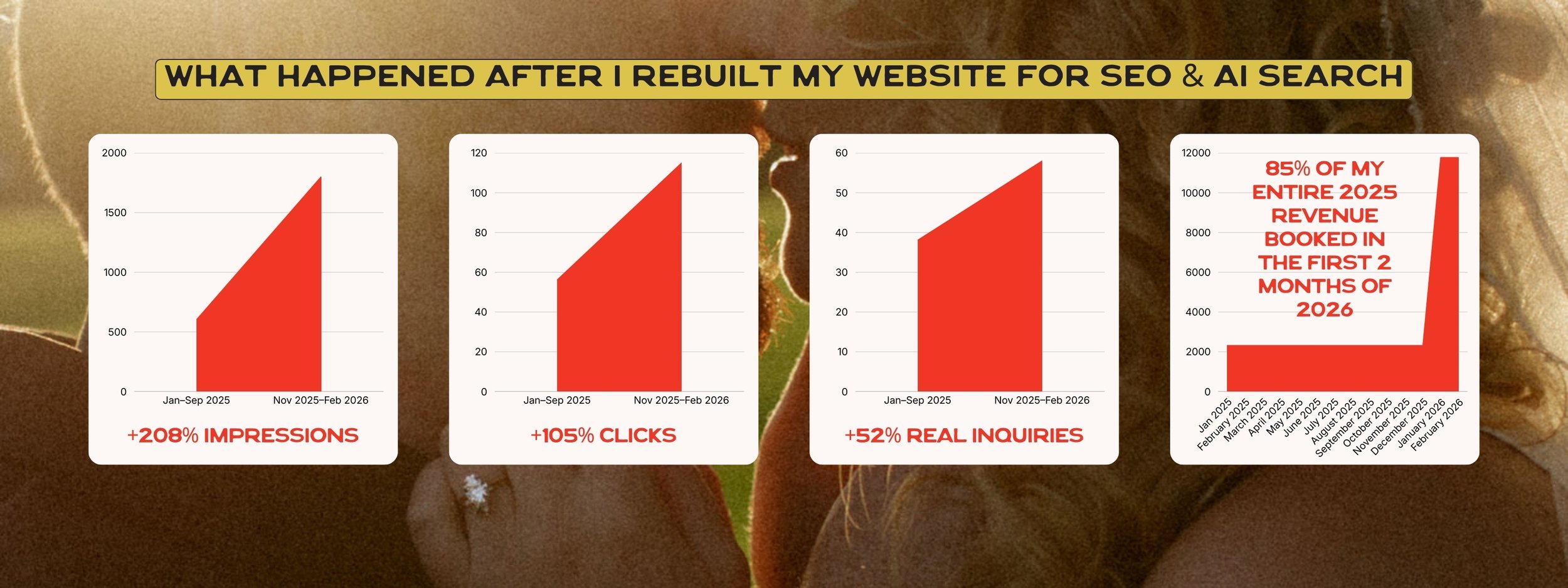
Real results from restructuring my photography website for search. Increased visibility led to more qualified clicks, more real inquiries, and significantly higher booking momentum going into 2026.
There were a lot of nights I found myself awake at 2am nursing my baby, staring at my website on my phone, trying to understand why my work suddenly felt invisible online.
My inquiries had slowed down in a way that didn’t make sense to me. Nothing about the way I photographed weddings had changed. Nothing about the way I cared for my clients had changed. But something had — and I couldn’t figure out what.
At the same time, I was navigating the transition back into my individual brand after My Whole Heart Collective came to a close. Logistically it was the right decision, but it was still a sad chapter to close and it left me doing a lot of reflecting about where my business was headed.
Photography isn’t just a job for me. I’ve been doing this for over a decade and I’m a third-generation photographer. My dad and my grandpa both had cameras in their hands long before I ever picked one up. So when my business started feeling like it was disappearing online, it hit deeper than just numbers.
I Gave Myself a Deadline — and Almost Walked Away
I want to be transparent about something: I’m not trying to book 50 weddings a year. I intentionally cap my calendar at 10 weddings so I can balance motherhood, family, and the kind of work I want to create. In all of 2025, I booked two weddings — both from friend referrals.
I quietly gave myself a deadline. If my website didn’t start showing up on Google by a certain point, I was going to close my books for weddings and return to the corporate world I had worked so hard to leave.
I wasn’t ready to give up on this. So instead of walking away, I started researching.
From May of 2025 until January 2026, I spent months teaching myself how search actually works — how Google reads a website, how AI search tools decide who to recommend, and what it actually takes for a photography business to show up consistently in search results.
I had purchased guides along the way hoping something would finally click. Most never explained this part clearly and honestly didn’t help me at all.
What I Realized Was Wrong With My Photography Website
My website wasn’t broken. It just wasn’t communicating clearly enough for search engines to confidently understand what my business represented.
What I slowly started realizing is that a lot of search visibility comes down to clarity. Once a photography website clearly communicates what you do, where you serve, and how the pages of your site connect together — things start shifting.
Search engines and AI tools are trying to answer one question: can I confidently send someone here? They evaluate your site based on five things:
What do you do?
Where do you do it?
Who is it for?
Are you trustworthy?
Are you consistent across platforms?
When those signals are missing or inconsistent, search engines hesitate. When they’re clear and consistent — across your page headings, your body copy, your image file names, your FAQs, your schema — confidence builds. And that confidence is what turns into visibility.
What Happened to My Photography Inquiries After I Restructured My Website
Between January 3rd and the end of February 2026, I booked the remaining eight weddings for my 2026 season. Six came from couples who found my photography website through Google once it finally started showing up in search. Two couples found me through ChatGPT recommendations — which says a lot about how search is evolving.
SEO Visibility Growth (Impressions)
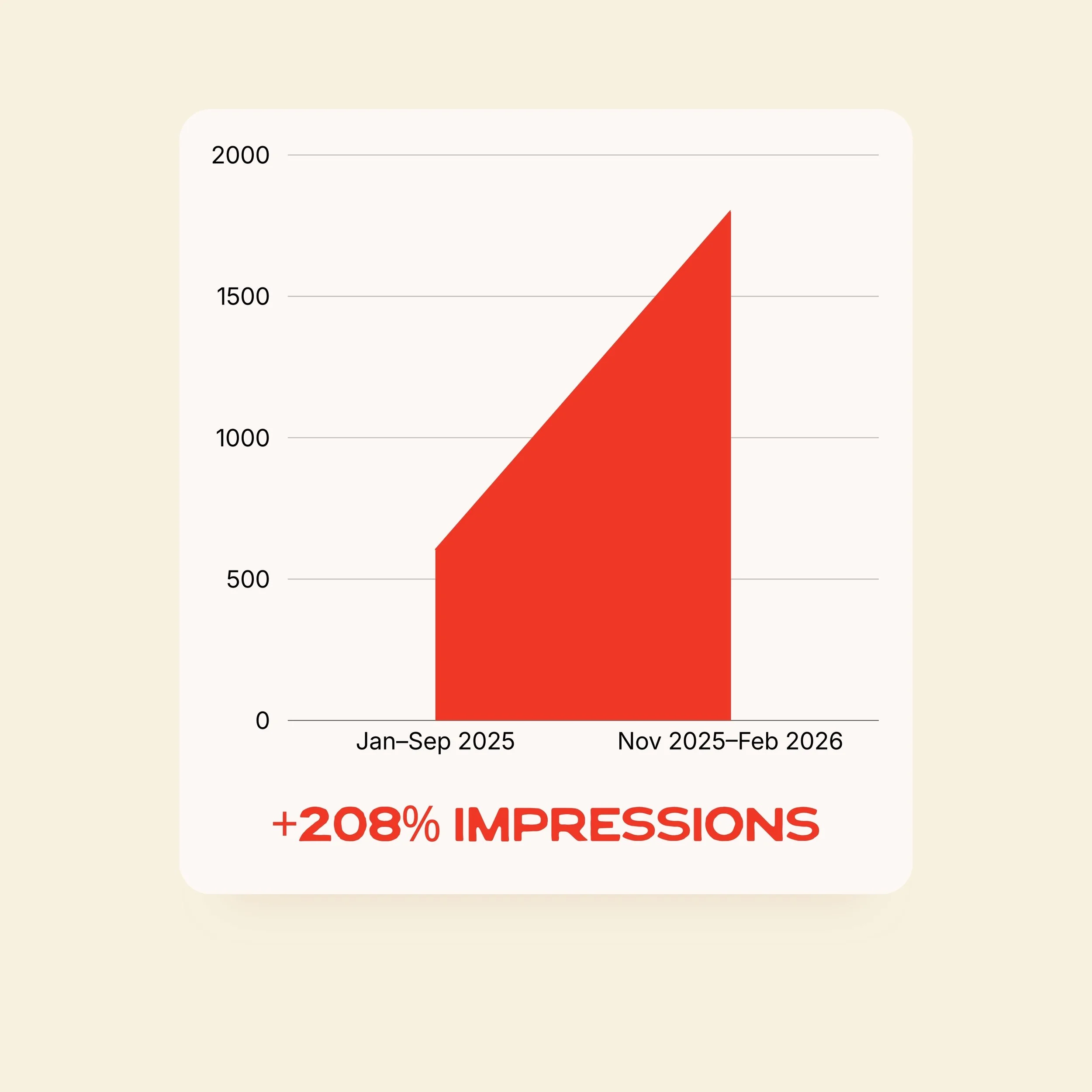
Google search impressions increased by 208% after restructuring my photography website for SEO and AI search visibility.
SEO Inquiry Growth
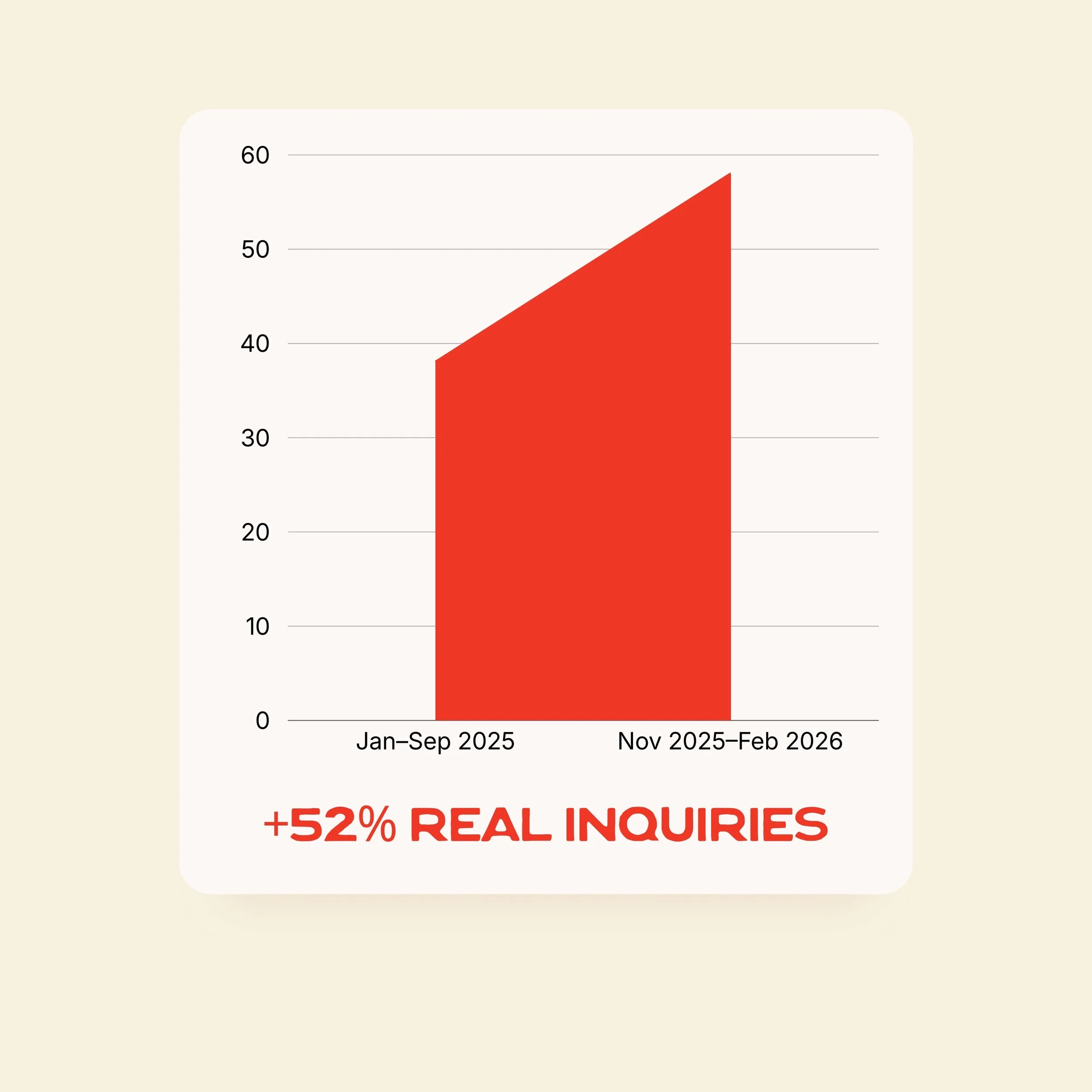
Real inquiries from potential clients increased by 52%, showing stronger alignment between search intent and the content on my website.
SEO Traffic Growth (Clicks)
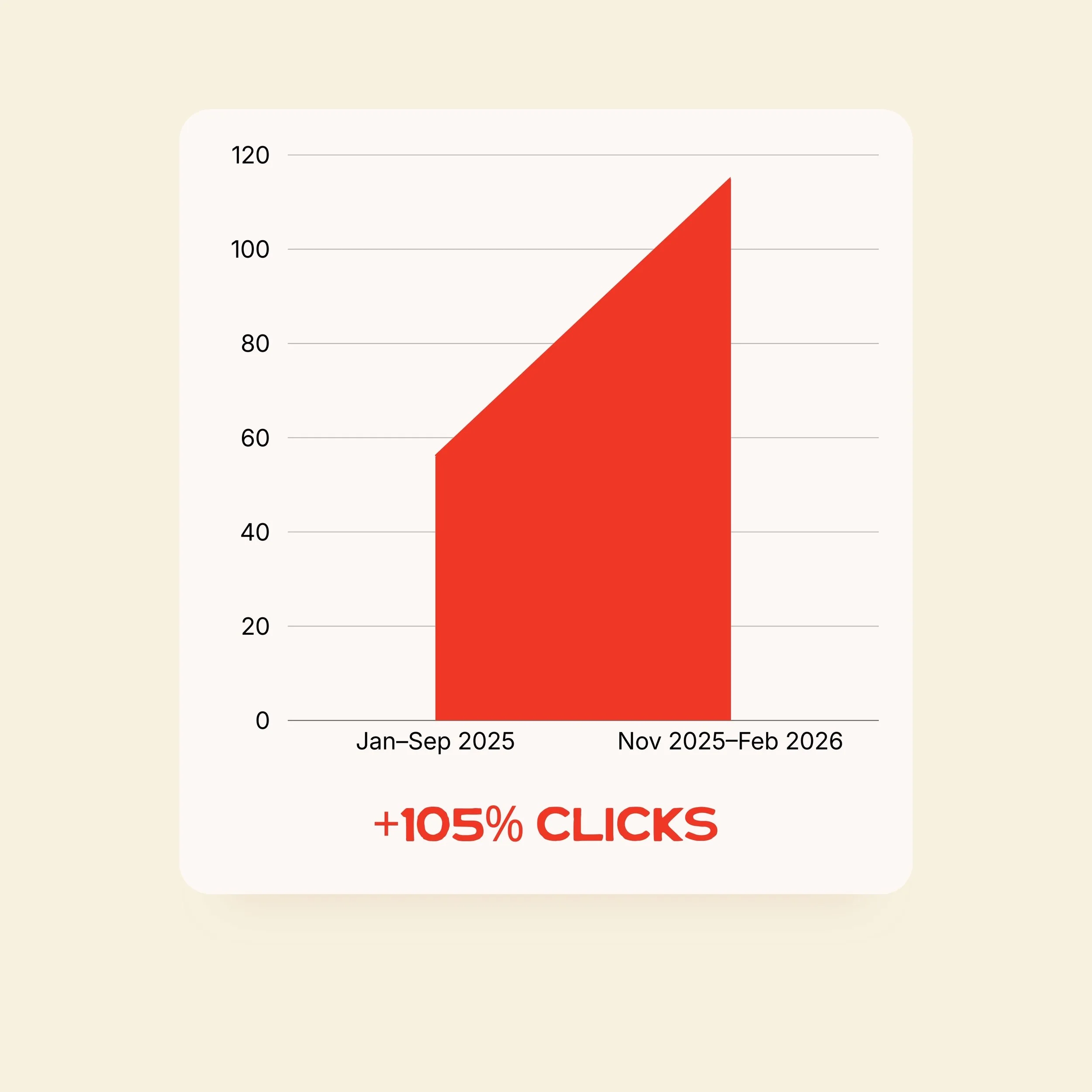
Clicks from Google search increased by 105% after improving the structure and search visibility of my photography website.
Revenue Impact of SEO Improvements
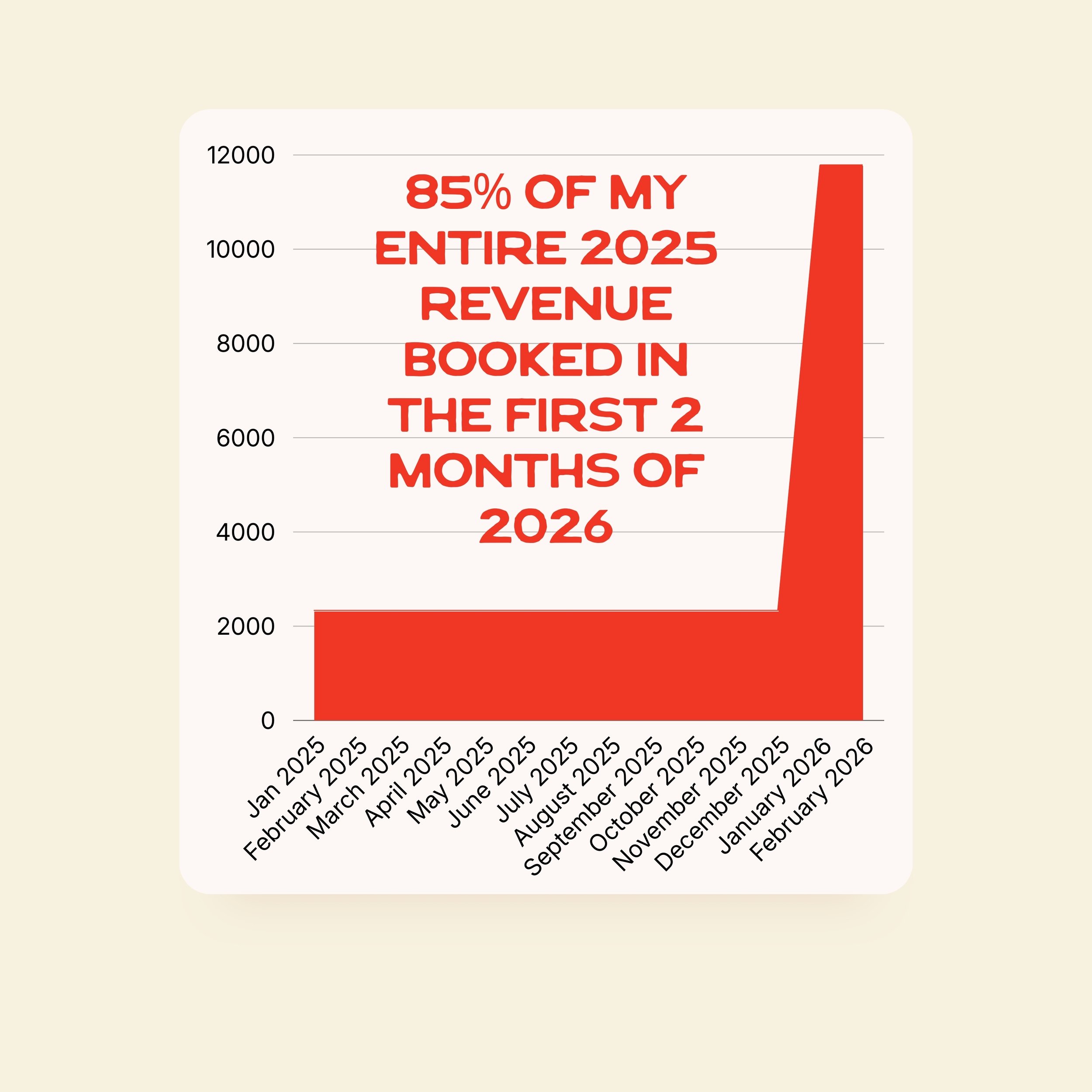
After rebuilding my website for SEO and AI search visibility, 85% of my entire 2025 revenue was booked in the first two months of 2026.
I didn’t change my editing. I didn’t change my pricing. I didn’t change my work. I changed my structure.
The Structural Changes That Helped My Photography Website Get Found
Once I understood the clarity framework, I started working through my website systematically. Not all at once — methodically, one piece at a time, mostly in those quiet 2am hours.
The changes that made the biggest difference:
Keyword clarity. I identified the exact words my couples search and made sure those words appeared consistently across my page headings, opening paragraphs, and image descriptions — in language that still sounds like me.
Page hierarchy. I restructured my H1 through H4 headings so search engines could understand exactly what each page is about and how the pages relate to each other across the site.
FAQ strategy for AEO. I rewrote my FAQ sections using the actual questions photographers and couples search for — not the questions I assumed they were asking. This is what gets your content pulled into AI search results.
Schema. I added simple structured data that reinforces the identity of my business to search engines. No coding required — just filling in a template.
Image optimization. Every image on my site now has a descriptive file name and alt text that works for both accessibility and search. It’s one of the most underutilized signals on most photography websites.
None of these pieces work on their own. They work together. When all of them are aligned and consistent across your site, search engines gain enough confidence to start surfacing your work to people who are actively looking for you.
Why AI Search Matters for Photographers Right Now
Two of my eight bookings in early 2026 came from couples who found me through ChatGPT. That’s not an accident and it’s not a fluke — it’s the result of a website that clearly communicates what it is.
AI search tools don’t interpret photography style or emotion the way humans do. They look for patterns, structure, and clarity. When a website clearly communicates what a business does, where it operates, and how its pages are organized — those signals become easy for AI tools to surface when someone searches.
That clarity is what allows your website to be referenced, summarized, and recommended when people ask an AI tool who the best wedding photographer in their area is. The stronger and more consistent your structure, the easier it becomes for these systems to understand what your website represents.
Search is evolving quickly. What remains consistent is that clarity helps. It always has.
How I Turned This Into a Framework for Other Photographers
As I worked through this process inside my own business, I started documenting everything I was learning — page structure, keyword clarity, image optimization, schema, and the way pages connect together across a website. Eventually that documentation became a framework.
I created this guide because I know there are other photographers sitting in the same place I was not long ago. Professional SEO services can be incredibly expensive — and that simply wasn’t attainable for me at the time. This framework is my way of making the foundational things I learned accessible to anyone who might need them.
If you work through the guide and need help understanding a piece of it, I’m always happy to help where I can within my own schedule. Sometimes all someone needs is a little clarity — or a hand to hold while they implement something new.
Common Questions About Photography Search Visibility
Why Isn’t My Photography Website Showing Up on Google?
Almost always a structure problem. Search engines need your website to clearly communicate what you do, where you serve, and how your pages connect together. If those signals are missing or inconsistent, Google can’t confidently show your site to people searching for you. It took me months of restructuring before things shifted — but once they did, the change was significant.
Why Did My Photography Inquiries Slow Down?
This was exactly my situation. Two bookings in all of 2025. My work hadn’t changed — but the way search engines were interpreting my site had. Once I restructured for clarity, I booked eight weddings between January 3rd and the end of February 2026. Six found me through Google. Two found me through ChatGPT.
Do I Need to Blog to Get Found on Google as a Photographer?
No. A blog can support your SEO, but your service pages and site structure do the heavy lifting. My results came entirely from restructuring my existing pages for clarity. I don’t maintain an active blog and my impressions still increased by 208%.
How Long Does SEO Take to Work for Photographers?
In my case, results started showing up within a few months of implementing structural changes. By January 2026, six couples had found and booked me through Google in under two months. The timeline depends on how much structural work your site needs — but the right changes move faster than most people expect.
How Do Photographers Get Found on ChatGPT or AI Search?
AI tools surface websites that are clearly structured and consistently answer specific questions. Writing FAQs in real-search-query format, structuring your H tags intentionally, and making sure your pages consistently answer who you are, what you do, and where you serve — that’s what gets you referenced. Two of my bookings came directly from ChatGPT after I made these changes.
What Is AEO and Why Does It Matter for Photographers?
AEO stands for Answer Engine Optimization — structuring your content so AI tools like ChatGPT, Perplexity, and Google’s AI Overview can extract and surface your answers directly in results. As more couples use AI search to find vendors, AEO is becoming just as important as traditional SEO. The framework covers both.
For Photographers Who Feel Like Their Work Has Gone Invisible
Running a creative business can feel deeply personal, especially during seasons when things feel uncertain. There were moments during the past year where I questioned whether I had somehow lost my footing — or whether the work I cared about had quietly slipped out of reach.
What I discovered instead was that the work was never the problem. My website simply needed help being understood.
Once search engines could clearly understand my business again, the visibility followed. And with that visibility came the couples whose stories I get the privilege of documenting.
If you’re in that place right now — the framework is here when you’re ready. You can find it here: The SEO & AI Invisibility Framework for Wedding Photographers
Nicole Kilday is a wedding photographer based in Hebron, Illinois. She photographs weddings throughout Northern Illinois, Chicago, Lake Geneva, and Southern Wisconsin. After restructuring her photography website for search visibility, Nicole increased her Google impressions by 208%, clicks by 105%, and booked eight weddings in the first two months of 2026 — six from Google, two from ChatGPT. She documents this process in the Search Visibility Framework for Photographers, a $127 digital download covering keyword clarity, page structure, FAQ strategy for AEO, schema templates, and image optimization.
